How to Keep a Group Together on a Road Trip
To keep a group together on a road trip, put every car on one shared live map, agree on regroup points before you leave, and drive in a lead-and-sweep formation — the lead car sets the pace and the sweep car stays last so no one gets left behind. Those three habits prevent the usual failure: cars separating at exits, traffic lights, and gas stops, then burning twenty minutes reuniting by phone.
The short version
- One shared live map — every car visible in real time, so nobody texts “where are you?”
- Regroup points every 45–60 minutes — agreed before you leave, not negotiated at 70 mph.
- Lead and sweep — a pace-setter up front and a last car watching the back.
- Hands-free comms — glanceable status messages and a real emergency channel, nothing you have to read.
We learned this the hard way: Vamio started because our own crew kept getting split up on night drives. Below is what actually keeps a group together, whether you’re running a 3-car crew or a full convoy.
Why do groups split up while driving?
Groups split for predictable reasons. Cars accelerate at different rates after a light, someone misses an exit, a fuel stop runs long, or one driver hits traffic the others have already cleared. Texting can’t fix it in the moment — the driver who’s lost is exactly the one who shouldn’t be looking at a phone. So the fix isn’t more messaging; it’s shared awareness. When every car can see where the others are at a glance, a separation stops being a panic and becomes a minor course-correction. Solve for visibility first, and most of the other problems take care of themselves.
Put everyone on one shared live map
The single most effective habit is getting all the cars onto one shared live map for the trip. Instead of texting back and forth, each driver glances at a map and sees every car move in real time. Group-driving apps like Vamio do exactly this: the whole group joins one “drive,” everyone appears on the same map, and a typical hour-long drive uses only about 5–10 MB of data — less than streaming a single song. Location is shared only during the active drive and stops the moment it ends, so you get coordination on the road without anyone being tracked for the rest of the trip.
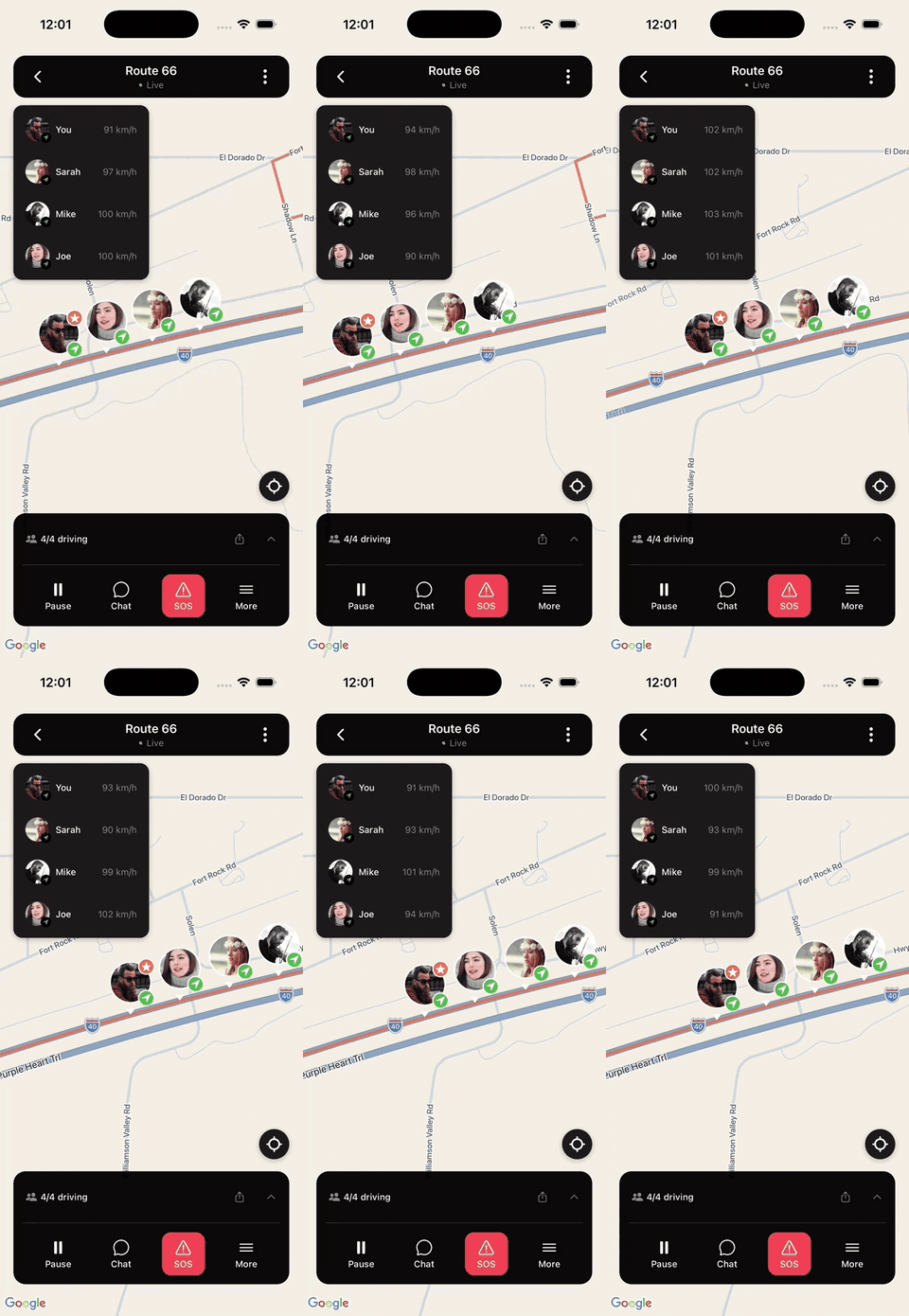
Agree on regroup points before you leave
Decide your stops before you pull out of the driveway, not over the radio mid-highway. Pick a regroup point roughly every 45–60 minutes — a specific gas station or rest area, named in advance, not a vague “next exit.” Share the full route and the stop list with every driver, so a car that falls behind always knows the next place the group will be. Clear stops turn a separation from a crisis into a non-event: the car that got cut off simply continues to the agreed point, and the group waits there. No frantic calls, no doubling back.
Drive in a lead-and-sweep formation
Assign two roles for the whole trip. The lead car sets the route and the pace, and never speeds up to “drop” the back of the group. The sweep car drives last and calls out when the group is bunched up or strung out too far. With those two roles fixed, every car in the middle only has to keep the vehicle ahead in sight — a much simpler job than tracking the whole group. This is how organized convoys, motorcycle packs, and overlanding crews have run for decades: two clear roles do more for cohesion than any amount of mid-drive texting, because the structure holds even when the map app doesn’t.
Keep communication hands-free
Anything a driver has to read or type is a safety hazard. The U.S. National Highway Traffic Safety Administration notes that taking your eyes off the road for the five seconds a text takes is, at 55 mph, like driving the length of a football field with your eyes closed (NHTSA). So keep communication to quick, glanceable signals: a shared map, one-tap status messages (“pulling over,” “need gas”), and a genuine emergency channel. Vamio includes in-drive chat built for this and a one-tap SOS that alerts everyone in the drive with your exact location if you break down or have an accident (more on how we handle safety). The rule of thumb: if a tool needs more than a glance, it belongs to the passenger, not the driver.
How big a group can you coordinate?
You can coordinate anything from a 3-car crew to a large caravan, but keep each map manageable. On Vamio’s free plan, a single drive holds up to 20 people on one live map; for a bigger event, split into multiple drives and pair up the leads. Smaller, well-coordinated groups almost always travel better than one giant blob of cars — a tight group of 20 that all see each other beats 50 vehicles scattered across ten miles of highway. If you’re scaling up, the trick is structure, not size: several coordinated drives in parallel keep everyone visible without overloading a single map.
A pre-trip checklist
Run through this before you pull out:
- Everyone’s on the same live map. Invite link sent, every car showing.
- Route and stops shared, with regroup points set every 45–60 minutes.
- Lead and sweep assigned — pace-setter up front, last car watching the back.
- Phones mounted and charging. Nobody holds a device while driving.
- An emergency plan everyone knows — how to send an SOS, and where to wait if separated.
Coordinate your next road trip with Vamio
Vamio is a free group-driving app for road trips and convoys on iOS 16+ and Android 10+. Start a drive, share one invite link — no sign-up required for your crew to join — and everyone stays on one live map from departure to destination. Download Vamio before your next trip and keep the whole group together.
